


Ukrainians in Germany
An overview of what is known about Ukrainians in Germany
Headline statistics
- In 2018, there was a total of around 322,000 Ukrainian migrants living in Germany
- This corresponds to 3.9 Ukrainians per 1,000 people
- In 2019, over 70% of Ukrainian migrants in Germany were in gainful employment
- 57% of Ukrainian migrants and nationals in Germany are women (compared to 51.1% for native Germans)
- In the past, roughly half of Ukrainians in Germany have held a university or college degree (compared to 18.5% amongst all German residents)
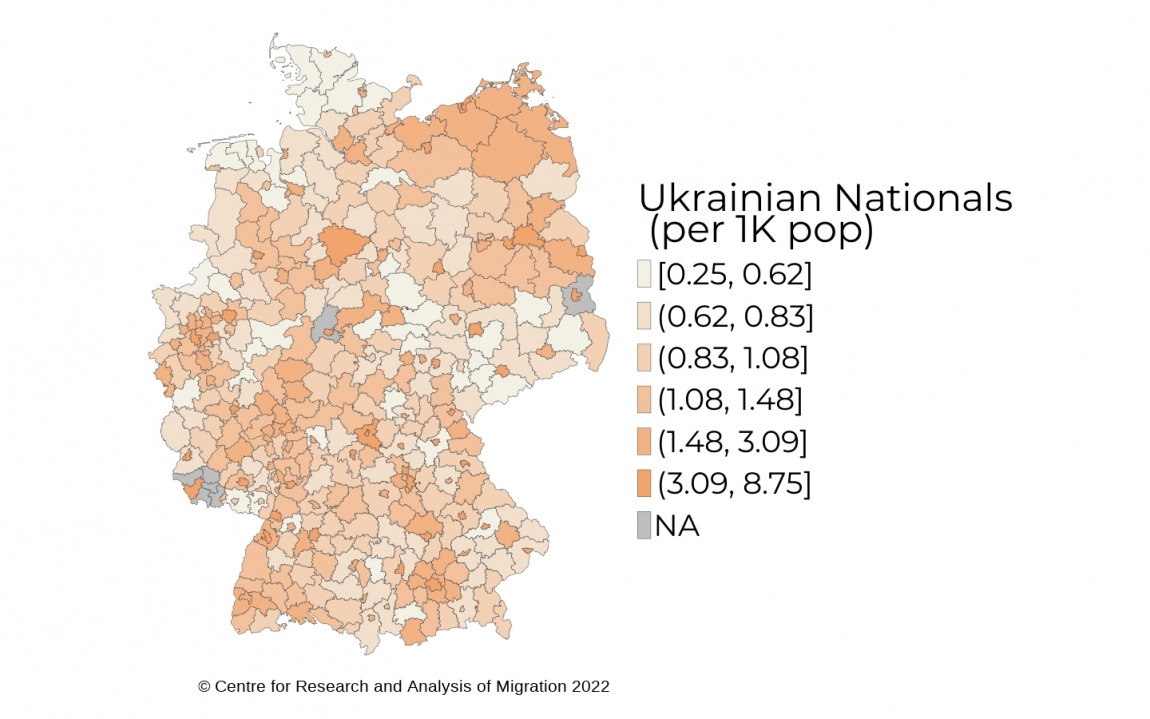
Where do Ukrainian nationals reside in Germany?
Sources and technical notes
Source: own calculations based on Genesis, Statistisches Bundesamt, tables 12521-0041 and 12411-0016.Data reveals that in terms of absolute numbers, there are clusters of Ukrainian nationals in urban areas; in 2020, the three cities home to most Ukrainians were Berlin (12,965), Munich (7,270) and Hanover (4,325). Ranking municipalities by the share of Ukrainian nationals in the population, one finds that Baden-Baden (0.87%), Nuremberg (0.82%) and Schwerin (0.72%) form the top three regional clusters. Interestingly, whilst foreign nationals predominantly reside in the former West Germany, the share of Ukrainians amongst the foreign population in the former East Germany is considerably higher (Kosyakova, 2022). In other words, Ukrainian nationals are more likely to reside in East Germany than other foreign nationals.
If one does not only take nationals but also those with migratory background into account, the total number of Ukrainians in Germany amounted to 322,000 in 2018 (Brücker et al., 2022a).
What do we know about Ukrainian nationals and migrants in Germany?
In terms of age and gender composition, it is striking that Ukrainian nationals in Germany are more likely to be female as well as older on average, relative to both other non-Germans as well as the population as a whole.
| Ukrainian nationals | All non-Germans | All residents | |
| Mean Age | 42.6 | 37.5 | 44.6 |
| % younger than 18 | 10.1% | 15.1% | 16.5% |
| % Women | 63.9% | 46.6% | 50.6% |
Sources and technical notes
Source: Data refers to Ukrainian nationals rather than all those with Ukrainian migratory background; all data taken from Statistisches Bundesamt, Genesis, table 12521-0003 as well as Bevölkerungsfortschreibung and Ausländerzentralregister (AZR). Mean age based on own calculations. Data refers to 2020.Examining the labour market outcomes of Ukrainian nationals in Germany towards the end of 2021, we can see that their employment and unemployment rates are not too dissimilar to the overall non-German population. However, a smaller percentage is in receipt of SGB II benefits.
| Ukrainian Nationals | All non-Germans | All residents | |
| % employed | 52% | 53.8% | 68.6% |
| % unemployed | 11% | 12.4% | 6.0% |
| % in receipt of SGB II benefits | 13% | 18.3% | 7.9% |
Sources and technical notes
Source: Data in this table refer to Ukrainian nationals rather than all those with Ukrainian migratory background; all data is based on IAB data taken from Brücker et al., 2022a and Brücker et al., 2022b. Employment and unemployment rates reflect December 2021, SGB II rates refer to October 2021.As opposed to the IAB employment data, other data sources such as the SOEP or Microcensus also cover Ukrainian migrants that now hold German nationality (rather than just Ukrainian nationals) as well as self-employment. Examining data from the 2019 IAB-SOEP-Migration-Sample as well as the 2018 Microcensus, Brücker et al. (2022a) report that Ukrainian migrants in Germany have been predominantly female (57% compared to 51.1% among German natives), well qualified (roughly half held a university or college degree compared to 18.5% amongst all German residents) and well-integrated into the labour market (over 70% in gainful employment depending on the sample used). Furthermore, in 2019, 73% of Ukrainians living in Germany had good or very good command of the German language.
References
- Kosyakova, Yuliya (2022): „Regionalstruktur ukrainischer Communities in Deutschland“, IAB, Nürnberg
- Brücker, Herbert; Goßner, Laura; Hauptmann, Andreas; Jaschke, Philipp; Kassam, Kamal; Kosyakova, Yuliya; Stepanok, Ignat (2022a): „Erste Einschätzung der Folgen des Krieges in der Ukraine für Migration und Integration“. (IAB-Forschungsbericht, 2/2022), Nürnberg, 65 S.
- Brücker, Herbert; Hauptmann, Andreas; Keita, Sekou; Vallizadeh, Ehsan (2022b): Zuwanderungsmonitor. Sonderauswertung für ukrainische Staatsangehörige. Institut für Arbeitsmarkt- und Berufsforschung.
- Statistisches Bundesamt (2019): Bevölkerung nach Bildungsabschluss in Deutschland, accessed March 13, 2022
- Statistisches Bundesamt (2020): Bevölkerung nach Nationalität und Geschlecht 1970 bis 2020 in Deutschland, accessed March 13, 2022
- Statistisches Bundesamt (2020): Erwerbstätigenquoten 1991 bis 2020, accessed March 13, 2022