


Refugee Migration and the Labor Market: Lessons from 40 Years of Post-arrival Policies in Denmark
In a new CReAM discussion paper, the authors bring together evidence from four decades of Danish refugee policies to shed light on policies aimed at the labor market integration of refugee migrants.
How to integrate refugees into the labor market?
Refugee immigration, defined as immigration that appeals to the 1951 Geneva Convention, its subsidiary agreements, and extensions of its interpretation, has received much attention over the past years. Many countries have introduced, or are currently discussing, reforms to their asylum procedures, the way they prepare refugees for the labor market, and how they administer transfers and financial support. To inform current policies, one can learn from past experiences. In a new CReAM discussion paper (Arendt, Dustmann and Ku 2022), we investigate the impact that different immigration and integration policies have on refugee immigrants, focusing in particular on their labor market outcomes.
Learning from Danish refugee policies
The context of our study is Denmark, a country that has accepted refugees from a large variety of countries and for more than four decades (see Figure 1). Denmark has also frequently changed policies and regulations concerning integration programs, transfer payments, and conditions for permanent residency. This provides, together with excellent administrative data, a perfect laboratory to evaluate reform effects on refugees and their families, allowing us to study not just the immediate effects of policies, but also how they affect outcomes in the longer run. We focus on four groups of policies and their effects on the labor market attachment and performance of refugee immigrants: (i) dispersal policies for newly admitted refugees; (ii) employment support policies and language programs; (iii) changes in welfare benefit transfers; and (iv) policies that set out conditions for permanent residency. We review existing studies that evaluated these policy changes and draw the following conclusions.
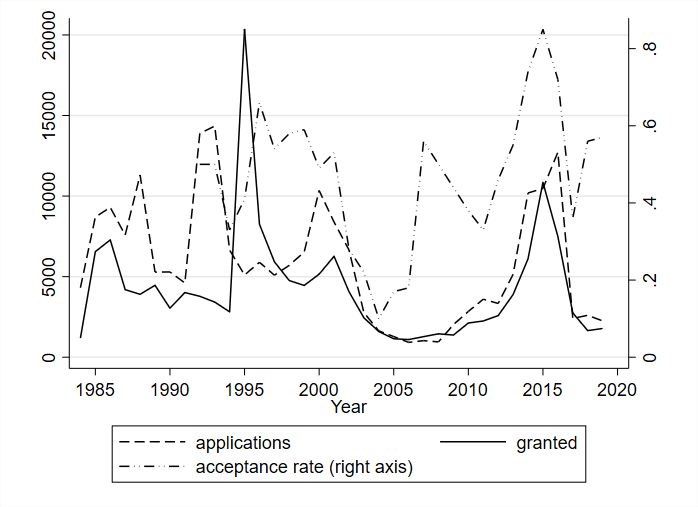
Notes: Asylum applications excludes applications from persons who are sent to other EU-countries (via the Dublin convention). Granted asylum includes protection under the UN convention (incl. quota agreements), subsidiary protection, and protection for other humanitarian reasons. The acceptance rate is for applications for asylum on Danish territory under the United Nations Geneva Convention relating to the Status of Refugees (GCR) only. Source: Arendt, Dustmann and Ku (2022)
Dispersal policies
Newly admitted refugees are often subject to dispersal policies, whose primary objective is to spread the burden of accommodating refugee immigrants evenly across the country that provides protection. Existing studies, however, show that refugees benefit from areas with large ethnic networks and better labor market conditions, as well as from bigger cities (where opportunities to find jobs in high-wage industries are more abundant). In contrast, quasi-random dispersal, may induce inefficiencies, by preventing refugees to settle in areas where their skills are most employable and obtain the highest reward. Even worse, policies that allocate according to cheap housing – often correlated with local disadvantage – my lead to long term disadvantage of refugees.
Employment support policies and language programs
Based on our review of studies that evaluate employment support policies including language programs and job training programs, we find that on-the-job training promotes employment chances of refugees, with job training programs administered early on being most effective in enhancing labor market entry. Studies also find that language programs enhance employment probabilities, although effects are found to materialize only in the longer run. However, there is some evidence of a trade-off between job training programs and language programs, where early job training may lead individuals to not acquire language proficiency, which may then have detrimental longer-term consequences by obstructing access to higher level employment opportunities.
Welfare benefits and transfers
A reduction in welfare benefits and transfer payments is often advocated on the ground that it incentivizes the labor market participation of refugee immigrants. Studies for Denmark that evaluate such welfare reforms show indeed a short-term response in employment probabilities, mainly for males. However, such short-term responses do not carry over into the longer run and cease after five years. Moreover, the reduction in disposable income for affected households has many undesirable side effects, pushing many households below the poverty line and leading to higher criminal activity of refugees as well as their children.
Permanent residency rules
Many countries have tightened the rules governing eligibility for permanent residency or citizenship in recent years, often motivated by a desire to provide incentives to integrate. The idea is that the economic benefits of permanence are so large that refugees – if tasked with investments into skills in exchange for permanent residency – will respond accordingly, which leads to stronger labor market integration. However, this may only materialize if the bar for obtaining permanence is not set too high. Reviewed research shows that more demanding permanent residency requirement can indeed provide such incentives, but only if individuals believe they can fulfil the new requirements without too large costs. Otherwise, more severe requirements can lead to lower labor market performance.
So which policies work and which do not?
Many of the policies discussed above share the aim to raise labor market participation, and we can compare their effectiveness in this dimension. As emphasized in several of the studies we reviewed, this requires understanding not just the short-term effects, but also the long-term response, as well as considering potential unintended consequences. Among the four broad groups of refugee policies evaluated in this study, only two produce effects that on average seem to outweigh costs: To allow refugees to choose where to settle, and active labor market programs that raise language skill investments. By contrast, policies that emphasize early job-training and policies that regulate access to welfare benefit or use permanence of residence to incentivize skill investment, while beneficial for some, create disadvantage for others.
References
Arendt, Jacob Nielsen, Christian Dustmann and Hyejin Ku (2022). “Refugee Migration and the Labor Market: Lessons from 40 Years of Post-arrival Policies in Denmark”, CReAM Discussion Paper 09/22.