


Integrating displaced people: Evidence from post-war Germany
CReAM fellow Sebastian Till Braun discusses lessons from large-scale displacements after World War II for the integration of displaced people and their families.
The Russian attack on Ukraine has led to the largest and fastest-growing refugee crisis in Europe since 1945. According to the United Nations, more than 3.5 million people have fled to neighbouring countries since the outbreak of the war. Even before the war, more people had been forcibly displaced than ever before. Within a decade, the number of displaced people has doubled to over 82.4 million worldwide (UNHCR 2021). These shocking developments have also revived interest in the mass displacements in Europe after the Second World War. The largest of these displacements was the flight and expulsion of Germans from Eastern, Central, and South-Eastern Europe, when 12 to 14 million people lost their home. This article summarises research findings on the integration of displaced people in West Germany after 1945.
Regional distribution
The 1950 census counted eight million displaced Germans, so-called expellees (Heimatvertriebene), in West Germany. Every sixth person was an expellee at that time. The proportion of expellees in the population varied greatly from region to region. For example, the three "refugee states" of Bavaria, Lower Saxony and Schleswig-Holstein together took in about sixty per cent of all expellees. At the county level, the expellee share ranged from 1.8 per cent to as much as 41.2 per cent (see Figure 1). There were two main reasons for this very uneven regional distribution. Firstly, in the last months of the war, the displaced fled to regions in the east and north of West Germany, which were close to home and within their reach in view of the war. Secondly, the French initially refused to accept expellees in their occupation zone. Furthermore, the expellees were mainly accommodated in rural areas where housing was more readily available than in the destroyed cities.
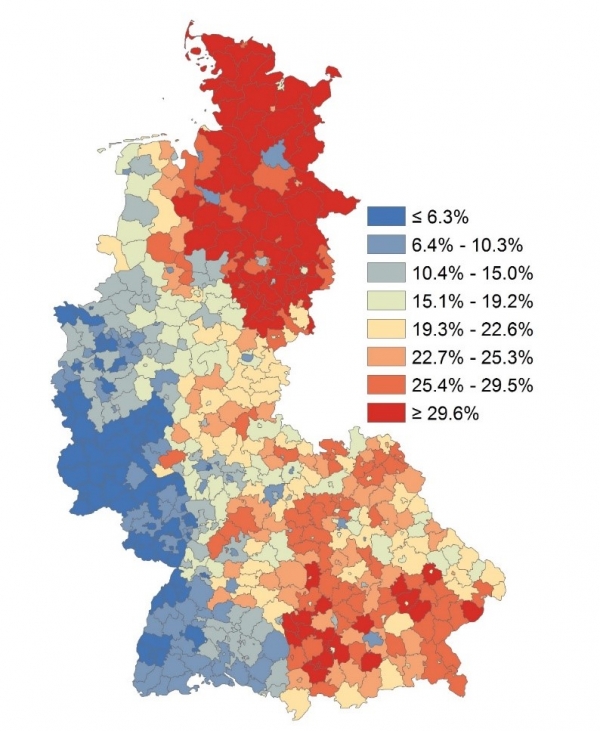
Figure 1: Population share of expellees in West German counties (in per cent), September 1950
Source: Own visualisation based on data from the population and occupational census of 1950. Underlying map: MPIDR (2011)
Data
The integration of the expellees was one of the central challenges for the young Federal Republic. Therefore, detailed data on the socio-economic situation of the expellees were collected until the 1970s. The population and occupational census of 1950, for example, contains detailed information on the occupational structure of the expellees. A recent study has digitised the data from the 1939, 1946, 1950 and 1961 population and occupational censuses and made them available to the public (Braun and Franke, 2021). In addition to the census data from 1939 to 1961, which are aggregated at the county level, data from the 1970 census and the 1971 microcensus are also available at the individual level. In the following, I present four insights on the economic integration of the expellees in West Germany, based on recent empirical analyses of these data sets.
Insights
Insight #1: The economic integration of the first generation remained incomplete
Building on earlier work by Lüttinger (1986), Bauer et al. (2013) examine how far the integration of expellees had progressed a quarter of a century after the end of the Second World War. The authors compare the economic success of displaced and non-displaced persons who had a similar socio-economic position before the Second World War. The focus is initially on the first generation of expellees. The study concludes that as late as 1970, the labour income of displaced persons was 8.1% (men) and 4.8% (women) lower than that of the native population. Their homeownership rate in 1970 was even 17.0% (men) and 26.1% (women) lower than that of the native population. Bauer et al. (2019) show that first-generation expellees were not only economically worse off than native West Germans but also faced a higher mortality risk.
For one group, however, the finding of incomplete integration does not apply, namely for those working as agricultural labourers in 1939. In this group, displaced persons earned significantly more than the native population in 1971 (Bauer et al., 2013). Underlying this result are dramatic occupational reallocation processes. After arriving in West Germany, many displaced agricultural workers left the agricultural sector and took up better-paid jobs in industry and the service sector.
Insight #2: Second-generation expellees succeeded in advancing through education
While the integration of first-generation expellees remained incomplete, the second generation succeeded in advancing through education. Expellee children born between 1944 and 1949 achieved higher educational attainment than native children of the same age (Bauer et al., 2013). In particular, the proportion of low-skilled persons without vocational qualifications was significantly lower among the children of displaced persons than among the children of the native population. The loss of land and assets forced expellee children to seek work outside agriculture and the parental farm. This made education more important for success in the labour market (Bauer et al., 2013; Lüttinger, 1986).
Insight #3: Resettlement location shaped integration outcomes
Labour market outcomes of expellees varied greatly from region to region. The 1950 labour-force-to-population rate of expellees, for instance, ranged from more than 50% in the west to less than 37% in the north and south-east of West Germany. Braun and Dwenger (2020) show that 60 to 70 per cent of these regional differences in labour force participation can be explained by the local expellee share and the regional importance of agriculture. Figure 2 illustrates that the higher the local percentage of expellees, the lower their participation in the labour force. This result supports the hypothesis that higher expellee shares intensified competition in the labour market (Braun and Weber, 2021). In addition, the economic integration of expellees was initially significantly less successful in agricultural areas than in more industrialised regions.
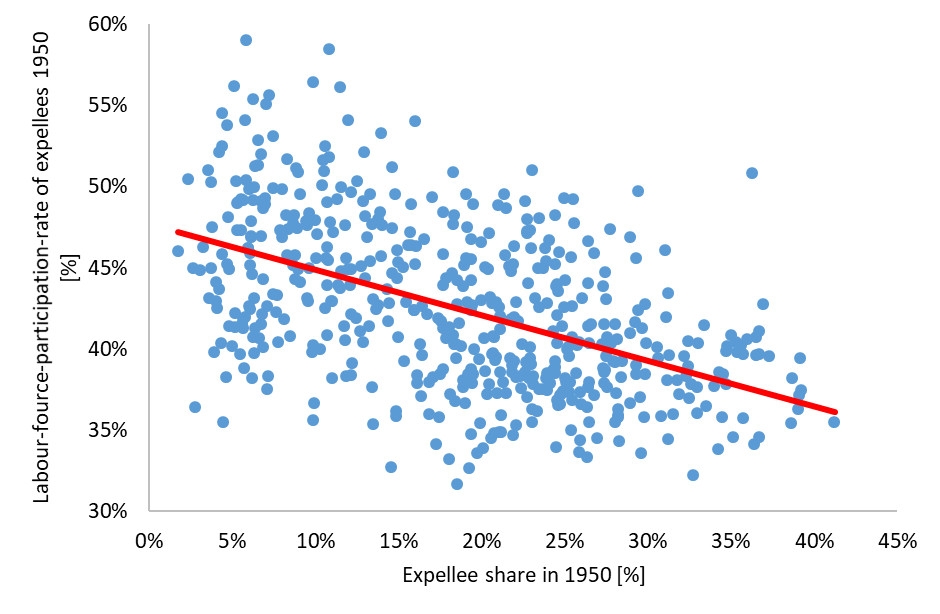
Figure 2: Relationship between expellee share and labour force participation of expellees, September 1950
Source: Own visualisation based on data from the 1950 population and occupational census. Note: Each dot represents a West German county.
Insight #4: Expellees moved to the jobs in the 1950s
High numbers of displaced people, especially in the rural areas of northern Germany, delayed their local economic integration. The expellees themselves reacted to the poor local labour market opportunities in the 1950s by moving on to the urban areas and industrial centres in western Germany (Ambrosius, 1996; Braun et al., 2021). Schleswig-Holstein, the federal state with the highest proportion of expellees, lost more than 10 per cent of its population in the 1950s. Expellees remained more regionally mobile than the native population in the following years (Bauer et al., 2013). The high mobility of expellees accelerated not only their integration but also the structural transformation of West Germany away from low-productivity agriculture (Braun and Kvasnicka, 2014).
Comparison with other displacements after the Second World War
There is also a growing literature on the other displacements that took place in Europe during and after the Second World War. In some cases, parallels to the results presented here for West Germany become visible. For example, Sarvimäki et al. (2022) examine the long-term consequences of the expulsion of Finns from Karelia. The paper shows that as late as 1971, the displaced achieved significantly lower incomes than the native population in the host areas. However, similar to Germany, this did not apply to displaced Finns who worked in rural areas and in agriculture before the war. They often left agriculture after the displacement and achieved higher incomes in the long run.
Parallels to the educational advancement of expellees in West Germany are documented by Becker et al. (2020) for Poland. The authors trace the educational history of Poles who were expelled from Kresy after the Second World War up to the third generation. Their study shows that Poles whose ancestors were displaced still have a significantly higher level of education than the descendants of non-displaced Poles. The authors attribute these differences to the fact that the displacement experience encouraged people to invest in "portable assets" such as education.
Conclusion
In summary, these results show that the integration of displaced people takes time. However, migrant children, in particular, have good chances if they get access to school education as quickly as possible. The local conditions at the resettlement location are also important for integration outcomes. The historical experience suggests that a strong regional concentration of the displaced in a few places—especially in rural regions—hinders integration. In contrast, the onward migration of expellees after resettlement has considerably accelerated their integration. This speaks against restricting refugees' choice of residence.
To learn more, you can read a VoxEU column on the effect of resettlement location on integration outcomes by Sebastian Braun and Nadja Dwenger. The data underlying most of the research summarised here is also available online.
A slightly modified version of this article will appear on Ökonomenstimme (in German).
References
Ambrosius, Gerolf (1996). Der Beitrag der Vertriebenen und Flüchtlinge zum Wachstum der westdeutschen Wirtschaft nach dem Zweiten Weltkrieg. Jahrbuch für Wirtschaftsgeschichte 1996/2: 39-71.
Bauer, Thomas, Sebastian Braun and Michael Kvasnicka (2013). The Economic Integration of Forced Migrants. Evidence for Post-war Germany. The Economic Journal 123 (571): 998-1024.
Bauer, Thomas. K., Matthias Giesecke and Laura M. Janisch (2019): The Impact of Forced Migration on Mortality. Evidence from German Pension Insurance Records. Demography 56: 25–47.
Becker, Sascha O., Irena Grosfeld, Pauline Grosjean, Nico Voigtländer and Ekaterina Zhuravskaya (2020). Forced Migration and Human Capital: Evidence from Post-WWII Population Transfers. American Economic Review 110 (5): 1430-63.
Braun, Sebastian and Michael Kvasnicka (2014). Immigration and Sectoral Change: Evidence from Post-war Germany. Journal of International Economics 93 (2): 253-269.
Braun, Sebastian T. and Nadja Dwenger (2020). Settlement Location Shapes the Integration of Forced Migrants: Evidence from Post-war Germany. Explorations in Economic History 77: 101330.
Braun, Sebastian T. and Richard Franke (2021). A County-level Database on Expellees in West Germany, 1939-1961. Vierteljahrschrift für Sozial- und Wirtschaftsgeschichte 108(4): 522-540.
Braun, Sebastian T. and Henning Weber (2021). How do Regional Labour Markets Adjust to Immigration? A Dynamic Analysis for Post-war Germany. Journal of International Economics 129: 103416.
Lüttinger, Paul (1986). Der Mythos der schnellen Immigration. Eine empirische Untersuchung zur Integration der Vertriebenen und Flüchtlinge in der Bundesrepublik Deutschland bis 1971. Zeitschrift für Soziologie 15 (1), 20-36.
MPIDR [Max Planck Institute for Demographic Research] and CGG [Chair for Geodesy and Geoinformatics, University of Rostock] (2011). MPIDR Population History GIS Collection (partly based on Hubatsch and Klein 1975 ff. and Bundesamt für Kartographie und Geodäsie 2011). Rostock.
Pfeil, Elisabeth (1958). Eingliederungschancen und Eingliederungserfolge: regionalstatistische Analysen der Erwerbstätigkeit, Berufsstellung und Behausung der Vertriebenen. Mitteilungen aus dem Institut für Raumforschung, Heft 35.
Sarvimäki, Matti, Roope Uusitalo and Markus Jäntti (2022). Habit Formation and the Misallocation of Labour: Evidence from Forced Migrations. Journal of the European Economic Association, forthcoming.
United Nations High Commissioner for Refugees (2021). Global Trends. Forced Displacement in 2020, Geneva.